When a property gets flagged for ADA non-compliance — or when you're proactively upgrading an accessible route — the work rarely ends with the ramp itself. ADA has explicit requirements, but local plan reviewers and inspectors look at the entire accessible path of travel. That's where secondary requirements come in, and that's where property managers get surprised.
What ADA Actually Requires
The ADA Standards for Accessible Design spell out the basics clearly: accessible routes must connect all elements of a site, ramp slopes can't exceed 1:12, handrails are required on both sides of any ramp with a rise greater than 6 inches, and level landings are required at the top and bottom of each run. Parking spaces designated as accessible require a specific stall width and an adjacent access aisle.
In Texas, commercial properties are also governed by the Texas Accessibility Standards (TAS), administered by the Texas Department of Licensing and Regulation. TAS aligns closely with federal ADA requirements and applies to all new construction and alterations across the state, including Houston.
On paper, that's the list. In practice, it's the starting point.
The Secondary Requirements Nobody Warns You About
When you pull a permit for ADA-related work, a plan reviewer examines the full accessible route — not just the item you flagged. If anything else along that route is deficient, it gets added to the scope. Here's what comes up most often:
Wheel Stops at Accessible Parking Spaces
Section 502.7 of the ADA Standards requires that parked vehicles not obstruct the clear width of adjacent accessible routes. The advisory language for that section specifically calls out wheel stops as the solution — and inspectors treat them accordingly. If a parked vehicle can pull forward onto a sidewalk or ramp landing and reduce the accessible route width below 36 inches, you have a documented compliance problem.
Here's where it gets layered. Accessible parking spaces are required to have signage, and that sign cannot be placed in the walkway or access aisle — doing so creates an obstruction on the accessible route, which is its own Section 502.7 violation. The correct solution is to mount the sign on a bollard positioned inside the parking space itself, keeping the pedestrian path clear.
But a bollard sitting in an open parking space is directly in the path of a reversing van. That's a real-world problem, especially at van-accessible spaces where drivers are already navigating a wider vehicle in a tighter situation. The fix is a wheel stop — it keeps the vehicle from backing into the bollard and keeps the bollard from becoming a liability. So what started as “we need a sign” becomes sign + bollard + wheel stop, and all three are defensible under the same Section 502.7 logic: protect the accessible route and everything in it from vehicle encroachment.
This is one of the clearest examples of how a single ADA line item cascades into a full scope of work that nobody budgeted for at the start.
Painted Ramp Surfaces
ADA requires that ramp surfaces be “firm, stable, and slip-resistant” (Section 302.1). It does not specify a coating, texture, or color. But inspectors expect to see it addressed, and bare concrete ramps that have been ground smooth or worn over time will get flagged. The practical standard in commercial settings is a rough, high-traction painted surface — typically in safety yellow or high-visibility white — applied to the ramp deck and sometimes the surrounding landing area.
This is where a lot of property managers spend money they didn't budget for.
High-Contrast Striping and Markings
Ramp edges, accessible stall boundaries, and access aisles are expected to be clearly marked and visible. Faded striping on a parking lot that's otherwise compliant will still get called out during an ADA review. If you're repainting a ramp, budget to refresh the surrounding lot markings at the same time.
Truncated Dome Detectable Warning Surfaces
At any point where a pedestrian route meets a vehicular way — curb ramps, drop-offs, hazardous vehicle areas — ADA requires a detectable warning surface (the raised bumps). These are often missing on older properties and get added to the scope when other ADA work is permitted.
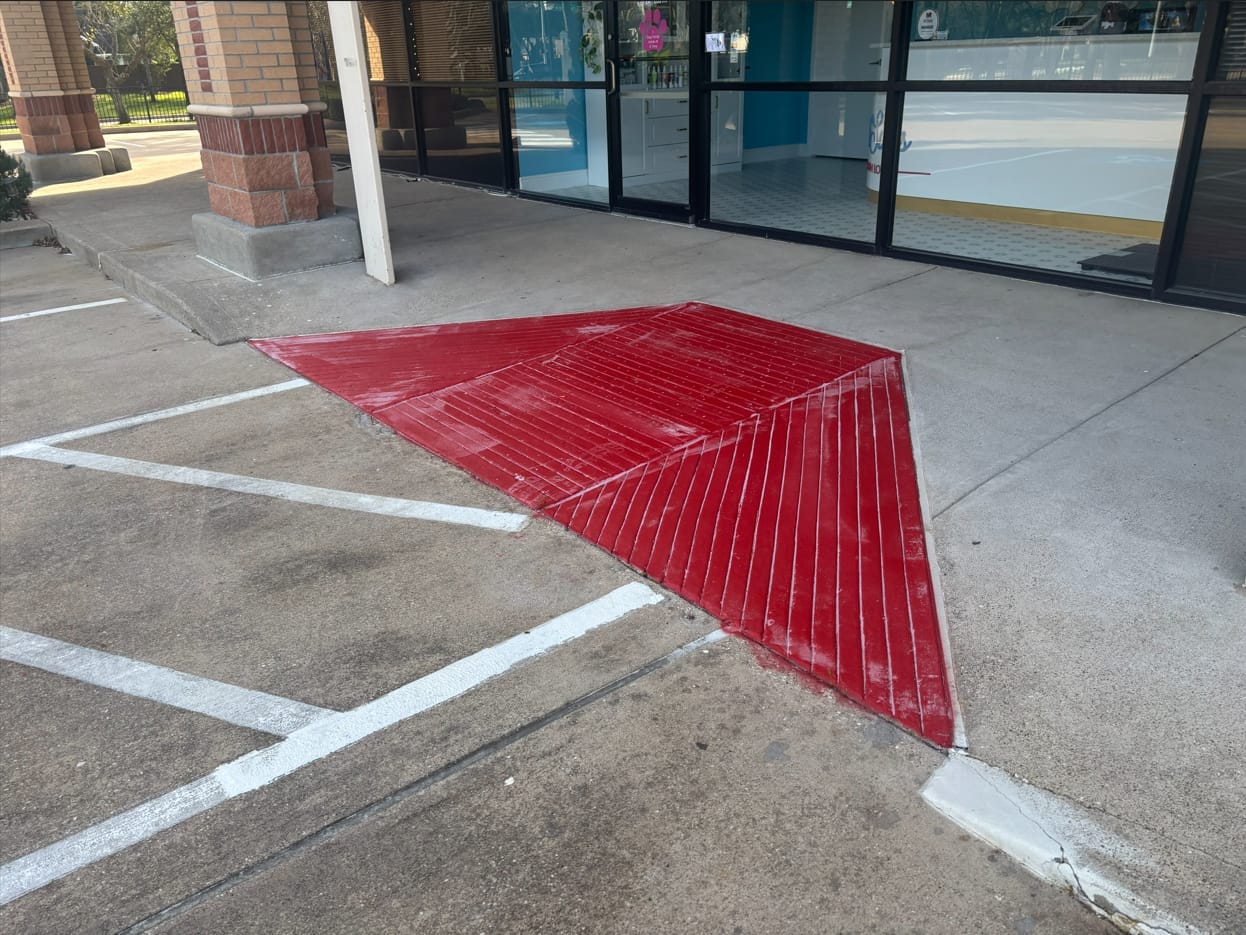
A properly finished ADA ramp includes a slip-resistant painted surface, clearly marked borders, and wheel stops protecting the accessible route from vehicle encroachment.
What to Use on the Ramp Surface
For exterior commercial concrete ramps, you need a coating that holds up to UV exposure, rain, and heavy foot traffic — and that dries to a genuinely aggressive texture, not just a slightly rough feel. Our go-to recommendation for this application is Tuff Grip Extreme Anti-Slip Coating. It's UV-stable, rated for exterior concrete, dries in 4–6 hours, and produces the kind of texture that actually holds traction in wet conditions. It comes in multiple colors so you can match safety yellow or standard gray depending on your property's requirements.
One gallon covers roughly 50–75 square feet depending on surface porosity, so measure your ramp area before ordering. For most standard commercial ramps, two coats are recommended for durability.
Budget for the Full Route, Not Just the Ramp
The most common mistake we see is scoping ADA work too narrowly. A property owner addresses the ramp and gets surprised when the permit triggers a review of the accessible stalls, the path from the stalls to the entrance, and the condition of existing markings. None of it is unreasonable — it's how the code is designed to work. The accessible route has to function as a connected system.
If you're planning ADA work, walk the full accessible path of travel before you budget. Look at the ramp, the landing, the stall markings, the access aisle, the curb transitions, and the wheel stops. Price it all at once. It's almost always less expensive to do it in one mobilization than to get surprised by a punch list after the permit is pulled.
ADA Compliance Services from MSM Services Texas
MSM Services Texas handles ADA ramp installation, handicap signage, accessible parking striping, wheel stops, and surface coatings for retail centers and commercial properties across Greater Houston. We ensure your property meets current Texas Accessibility Standards — and we catch the secondary requirements before they become violations.
Need an ADA compliance assessment for your property? Call 713-322-9095 or request a free quote. We'll walk your lot, identify every compliance gap, and give you a clear scope and price before any work starts.