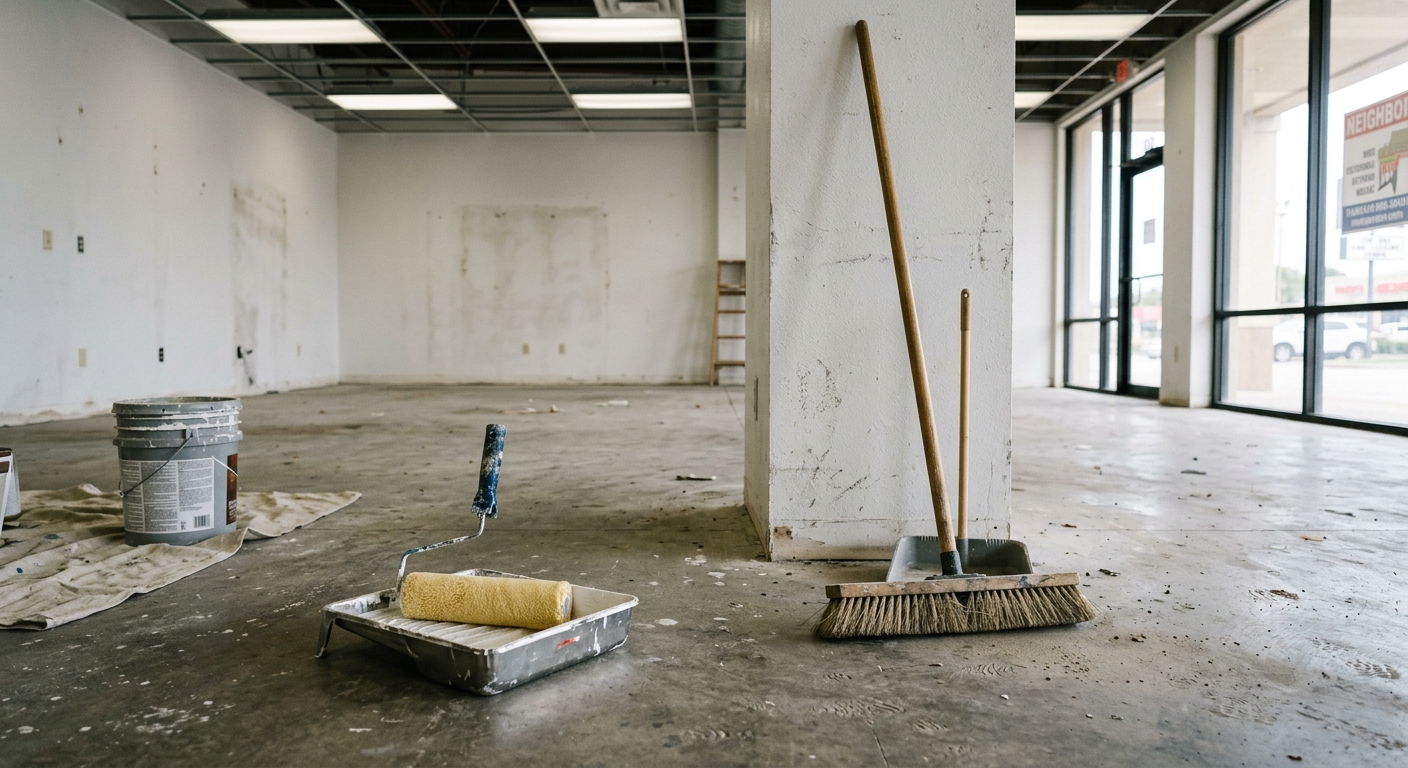
A vacant suite in as-is condition costs money two ways: lost rent every day it sits, and negotiating leverage handed to every prospect who walks through the door.
A vacant commercial suite costs money in two directions. Directly, through the rent you're not collecting. Indirectly, through the tenant improvement allowances and concessions you'll likely have to offer because the space went to market without being made move-in ready. In Greater Houston's retail and office market, the fastest path to a signed lease is almost always the same: get the suite to move-in-ready condition before the first showing, not as a post-LOI negotiating concession.
The math is not complicated. A 2,000 square foot retail suite at $20 per square foot NNN generates roughly $3,300 per month in base rent when occupied. Every 30 days it sits vacant costs you that $3,300 plus carrying costs. Commercial real estate brokers consistently find the same thing about curb appeal and property condition in competitive retail markets: move-in-ready suites with visible cosmetic improvements lease measurably faster — shortening vacancy and lifting tour-to-lease conversion — than comparable as-is spaces in the same center. A $4,500 turnover scope that cuts three weeks off the leasing timeline pays for itself in month one.
Across the retail centers and commercial properties MSM Services Texas maintains in Greater Houston, the gap between “as-is” and “lease-ready” is usually a few thousand dollars of work. The gap in leasing timeline can be measured in months.
Why As-Is Stays Vacant Longer
Most commercial real estate brokers will say the same thing: a prospect who walks into a suite and has to mentally subtract the bad paint, the damaged ceiling tile, and the dirty floors is harder to convert than one who walks in and starts placing furniture in their head. The visible condition of a space signals how the owner runs the property. It sets the negotiating temperature before anyone opens their mouth.
The problem compounds when a suite has been vacant for several months. Deferred maintenance that a departing tenant lived with — a hairline crack in the drywall, a flickering light, a scuffed base trim — becomes the first thing a broker photographs for their client's tour notes. Those photos show up in the letter of intent as requested tenant improvement allowances. Every deficiency you didn't fix before marketing became a negotiating chip you handed to the other side.
The Building Owners and Managers Association (BOMA) tracks occupancy performance across commercial property classifications. Properties in the top maintenance quartile consistently outperform the market on occupancy — not because the underlying real estate is better, but because the presentation is. A well-turned suite in a solid location closes faster and for better terms than an as-is suite in the same location. That spread is recoverable. You just have to spend the money on the front end instead of handing it over in the LOI.
What Move-In Ready Actually Means for a Commercial Suite
Move-in ready is not the same as “we painted it.” Move-in ready means a prospective tenant can sign a lease and hand their contractor the keys without needing an allowance to fix the landlord's deferred maintenance. For a retail or office suite in Greater Houston, that typically means:
- Walls patched, primed, and painted to a uniform finish. Not touched up — painted. A suite with five different shades of white from layered touch-ups and a decade of scuff repairs is not move-in ready. A flat repaint from a consistent starting point takes the conversation off the walls entirely.
- Ceiling tiles replaced where stained or damaged. Stained ceiling tiles are the single item most prospects notice first. They communicate active or recent roof problems whether there are any or not. Replace them before the first showing.
- Flooring cleaned or replaced. A thorough commercial floor clean often transforms worn-looking flooring. When it doesn't, and the flooring genuinely needs replacement, do it before marketing — not as a TI concession after the LOI.
- All fixtures functional. Burned-out lights, non-working HVAC registers, and broken switches are a $200 fix that costs thousands in negotiating leverage if left undone.
- Suite clean and odor-free. Post-vacancy cleaning goes beyond a sweep. Food service tenants leave odor in walls. Retail tenants leave adhesive residue, display marks, and traffic grime. The suite needs to smell and look like a fresh start.
The Interior Scope — What We Handle on a Suite Turnover
When MSM Services Texas gets called for a suite turnover, the scope typically falls into four buckets: interior repair and remediation, post-vacancy cleaning, minor electrical and lighting repair, and drywall and paint. We handle all four under one contract, which matters because the sequence is load-bearing — you clean before you paint, you patch before you prime, and you don't schedule a showing until all of it is done.
Drywall repair is where most suite turnovers start. Tenants hang things, move equipment, and sometimes modify walls without permission. The patches need to be done right — not skim-coated and forgotten, but properly floated and sanded so they disappear under paint rather than telegraphing through it. One of the most common callbacks we get from property managers who used a different contractor is paint going on over improperly prepped patches that are still visible under the new coat. That is a two-visit problem that should have been a one-visit job.
Post-vacancy cleaning for commercial suites is more involved than it looks. We cover hard floor cleaning and polishing, tile and grout work in bathrooms and break rooms, kitchen and food prep area degreasing, glass and mirror cleaning, ductwork vent cleaning, and debris removal. When a food service tenant has been in a space for several years, the cleaning scope is different from a quiet office tenant. We assess the specific condition of each suite before we price it.
The Exterior Side of the Equation
The suite condition matters. So does what a prospect sees before they get to the suite door. A well-prepped interior in a center with a dirty facade, cracked stucco, and faded signage is still a harder lease. The presentation story has to run from the parking lot to the suite door, not just start at the threshold.
On properties where a lease-up push is underway, we often run the exterior work alongside the suite turnover. Pressure washing the building facade and sidewalks removes the mildew and grime buildup that Houston's humidity accelerates. Visible stucco cracks and failed caulking at window and door frames read as deferred maintenance to any experienced broker or tenant. In some cases, a full center repaint makes the property look like it changed hands, whether it did or not — and that perception shift is exactly what a stale leasing pipeline sometimes needs.
A Turnover We Did in Katy
Last spring, a property manager called us about an end-cap suite at a strip center off the I-10 corridor in Katy. A restaurant tenant had vacated after four years — grease buildup in the kitchen area, adhesive marks from equipment and menu boards on every wall, stained drop ceiling tiles throughout, and two sections of drywall that had been cut into for an equipment install and improperly patched on the way out. The suite had been on the market in as-is condition for about six weeks with minimal prospect activity.
We scoped it in a single visit: full ceiling tile replacement in the kitchen and dining areas, drywall repair and full repaint on all walls, commercial degreasing and floor cleaning throughout, and pressure washing the exterior facade and sidewalk at the suite entry. Total scope came in under $6,500. We completed it in eleven working days.
The suite had a signed letter of intent within three weeks of going back to market. The broker who brought the deal specifically told the property manager the space “showed well” — which sounds like a small compliment until you consider that before the turnover, prospective tenants had been requesting $15,000 or more in tenant improvement allowances because the as-is condition of the suite was being used as a negotiating point. The turnover cost $6,500. The TI allowance in the signed lease was a fraction of what was being floated before. The math is not subtle.
ADA and Code Considerations During Commercial Alterations
One thing property managers sometimes encounter during suite turnovers: depending on the scope of the work, commercial alterations can trigger accessibility requirements that weren't part of the original plan.
The ADA Standards for Accessible Design specify that when alterations are made to a “primary function area” — a leased retail or office suite qualifies — the path of travel to that area must be made accessible to the extent that the cost does not exceed 20% of the overall alteration cost. In practice, a significant suite renovation can trigger a requirement to address accessible parking, the building entrance, or the route from the parking lot to the suite door if those elements are not already compliant.
In Texas, commercial properties are also subject to the Texas Accessibility Standards (TAS), administered by the Texas Department of Licensing and Regulation. For any alteration project that requires a permit, a TAS review may be part of the process. Getting ahead of those requirements — rather than discovering them after the work is scoped — is why we walk the full accessible route as part of our pre-turnover assessment on any larger scope.
For smaller turnovers — paint, clean, minor repairs — these requirements typically do not come into play. For a scope that includes structural modifications, new restrooms, or significant finish changes, it is worth a conversation with your contractor before work starts.
Timeline: What to Expect on a Typical Suite Turnover
Property managers always ask about timeline. The honest answer depends on the scope and the condition of the suite. Here is what we see most often:
- Standard turnover (paint, patch, clean, minor repairs) — 5–10 working days for a suite under 3,000 square feet.
- Moderate turnover (ceiling work, flooring, full clean, exterior facade wash) — 10–15 working days depending on material lead times.
- Full remediation turnover (water damage, mold treatment, full rebuild) — 3–6 weeks minimum, and often longer when insurance documentation is involved.
The variables that blow timelines are material availability, permit requirements, and sequential dependencies. Paint cannot go on until drywall is fully cured. Flooring cannot go in until the slab is clean and dry. We sequence the work correctly from the start, which is worth more than a low day-one estimate that produces callbacks.
For properties in Sugar Land, The Woodlands, Pearland, and Pasadena, we work across the full Greater Houston metro. Many of our suite turnover clients are property managers handling multiple properties, and most add their full portfolios to our maintenance program after the first job — because having a contractor who already knows every suite in your portfolio is worth a great deal when a tenant gives 30-day notice and you need to move fast.
Vacant Suite Turnover Services from MSM Services Texas
MSM Services Texas handles the full commercial suite turnover scope for retail centers, office parks, and mixed-use properties across Greater Houston — interior repair and remediation, post-vacancy cleaning, drywall and paint, ceiling work, exterior facade washing, and parking lot striping, all under one contract with one point of accountability. We assess the suite, scope the work honestly, and deliver it in the sequence and timeline we quoted. No callbacks, no surprise punch lists.
For existing maintenance clients, we prioritize turnovers because we already know the property, the suite finishes, and the property manager's approval workflow. For new clients, we will walk the property, document the condition of every vacant suite, and give you a clear scope and price before any work starts.
Ready to Get Your Vacant Suite Lease-Ready?
We'll walk the suite, document everything that needs attention, and give you a transparent scope and price — usually within 48 hours of the site visit. Most standard turnovers are on the schedule within a week.
Don't let a vacant suite sit in as-is condition through another leasing cycle. Call MSM Services Texas at 713-322-9095 or request a free estimate online. We serve retail centers, office parks, and commercial properties across Houston, Katy, Sugar Land, The Woodlands, Pearland, Pasadena, and the surrounding metro — and we will have your suite showing well before your next prospect walks in the door.