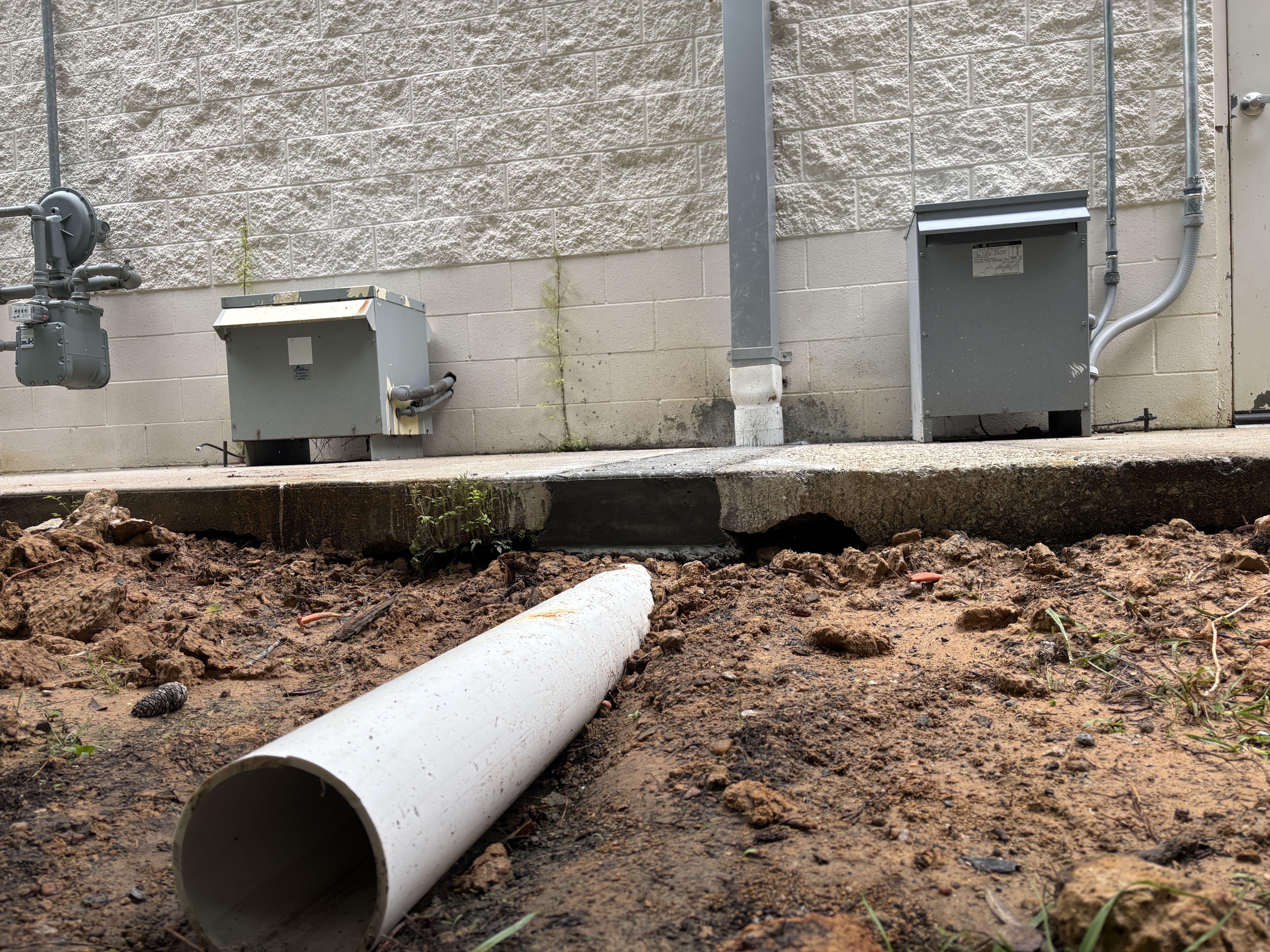
Look at the gap under that walkway. That is not settling. That is years of downspout water washing the soil out from under the slab, one storm at a time.
Walk behind almost any commercial building in Greater Houston and you will find the same thing. A service corridor with a permanent damp stripe down it. A soft, muddy trench where the concrete meets the dirt. A row of downspouts and AC condensate lines discharging straight onto the ground three feet from the building. Nobody walks back there. No tenant ever complains about it.
Across the properties we maintain, it is the single most common defect we find that has never once generated a work order. And it is quietly doing more damage to the asset than anything happening out front.
Every gutter and every rooftop unit on that building is a hose pointed at your foundation. The fix is not exotic. Run the downspouts and condensate lines into underground PVC and tie that line into the storm drain, the detention pond, or a ravine that is engineered to take it. Typical cost on a commercial property runs $7,000 to $15,000. Let the erosion run long enough and the cure stops being a drainage job and turns into a civil engineering project.
Run the Numbers on What Your Roof Is Shedding
One inch of rain drops about 0.62 gallons of water on every square foot it lands on. Take a modest 20,000 square foot strip center roof. A single two-inch Houston thunderstorm, the kind we get a dozen times a year, moves roughly 25,000 gallons through that gutter system in a couple of hours.
Now stretch it across a year. The National Weather Service puts Houston's normal annual rainfall at just under 50 inches. That same roof sheds around 620,000 gallons a year. If eight downspouts split the load, each one is putting roughly 78,000 gallons annually onto the dirt beside your slab.
Nobody would let a contractor park a water truck against the building and empty it every week. Functionally, that is what an unpiped downspout does.
The AC Units Are Doing It Too, Every Day, All Summer
Rain at least stops. Condensate does not. From May through October, every rooftop unit on the building is pulling water out of Houston humidity and dripping it somewhere, all day. On a multi-tenant center with a dozen RTUs, that is a continuous trickle onto the same patch of soil for six straight months. It is exactly why that spot behind the building never dries out.
It is also a code problem. The International Mechanical Code, Section 307.2.1 requires condensate to be conveyed to an approved place of disposal, and prohibits discharge that creates a nuisance. A permanent puddle across a walkway your tenants' employees use is not an approved place of disposal. It is a slip hazard, a mosquito breeder, and a mold source sitting on top of a structural problem.
When we pipe a building, condensate lines get tied into the same underground system as the downspouts. One trench, both problems gone.
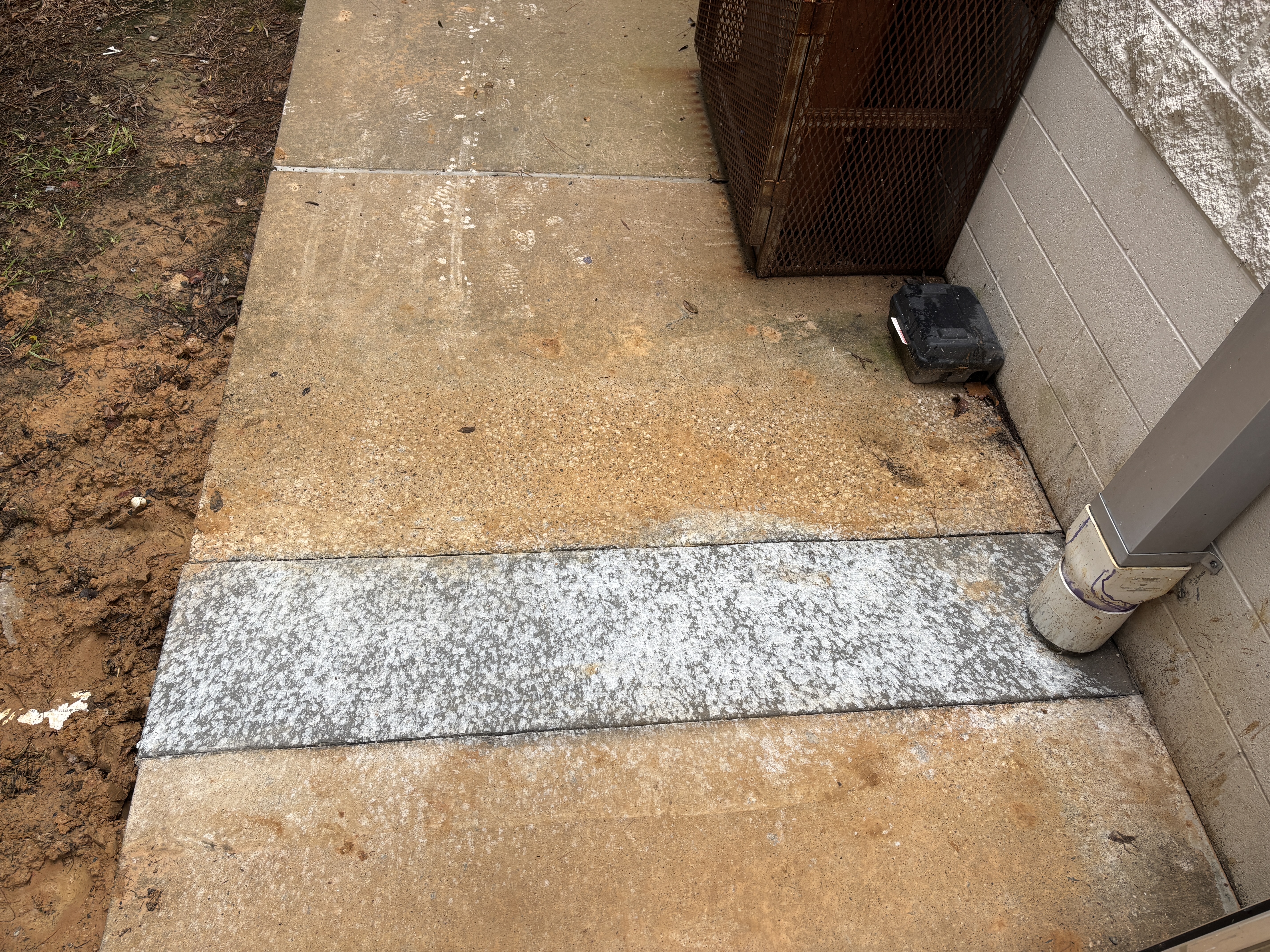
The finished connection. Downspout into a PVC boot at grade, saw-cut through the walkway, piped underground and out to the storm line. Nothing hits the dirt anymore.
Two Ways This Bill Comes Due
Owners tend to assume uncontrolled roof water is a cosmetic annoyance. It is not. It fails in two directions at once, and both of them are expensive.
1. The foundation moves
Houston sits on expansive clay. Clay swells when it takes on water and shrinks when it dries out, and it does this unevenly. That is the part that matters. When one edge of the slab sits in permanently saturated soil while the rest of the building bakes out every August, the two sides move in opposite directions. The building torques. You see it as stair-step cracks in the block, doors that stop latching, and separation at the storefront glass.
A commercial slab does not need six piers to stabilize. It needs dozens, plus interior demolition, plus tenant disruption and rent abatement while the work runs. And piering does not fix the cause. If the water still discharges next to the building after the piers go in, the clay keeps cycling and you buy the same problem twice.
2. The site erodes, and the fix becomes a civil project
This is the branch owners never see coming. Concentrated discharge does not soak in politely. It scours. It carries fines out from under sidewalks, aprons, and slab edges and leaves voids behind. It cuts channels through the back of the property and dumps sediment wherever it ends up.
Let that run for a decade and you are no longer buying a drainage tie-in. You are buying engineered erosion control: retaining and erosion-prevention walls, regraded and armored discharge channels, and in the worst cases a detention or retention basin built out to hold water the site can no longer shed. Anything that touches a regulated discharge point pulls in EPA stormwater rules and TCEQ permitting on top of the construction. Add the civil engineering, the survey, the permits, and the earthwork and a site that could have been piped for five figures becomes a six-figure remediation.
Foundation repair and site remediation are not alternatives. On a property that has been discharging onto raw dirt for fifteen years, they are usually the same invoice.
A Job in The Woodlands: The Corridor That Was Never Dry
The photos in this post are from a commercial property in The Woodlands. The complaint was not dramatic. The back of the building was simply always wet. Downspouts and condensate lines were dumping to grade in a service corridor, and the soil behind the walkway had been washing out for years.
You can see the result in the first photo. When we opened the trench, the ground under the edge of the walkway was simply gone, undercut in a void wide enough to put your arm into. From the top, that concrete looked fine. It was sitting on air.
We collected every downspout and condensate line into PVC boots, saw-cut the walkway, ran solid-wall pipe underground with fall the entire way, and daylighted it into the ravine at the back of the property, which is where that water was always supposed to go. The corridor is dry now. When it rains, the tenants will not notice anything at all. That is the whole point of the job.
We have also seen where this ends when nobody catches it. On another property, the joint between the walkway and the building had opened up so far that maintenance had been packing it with joint compound and sealant year after year, chasing the gap as it grew. Nobody asked why the gap kept coming back. The answer was that the soil under the walkway was leaving. Eventually the entire walkway failed and had to be demolished and re-poured.
If you are re-caulking the same joint every year, you do not have a caulking problem. You have a water problem.
How to Tell If Your Building Has This
You do not need an engineer to spot it. Walk the back of the building after a rain and look for:
- Downspouts or condensate lines terminating on soil, mulch, or a splash block
- A puddle or soft mud still there two days after the last rain
- A widening gap where the walkway meets the building, especially one that keeps getting re-sealed
- Erosion channels, exposed aggregate, or a trench where the concrete meets the dirt
- Voids or undercutting at sidewalk and apron edges
- Water staining, efflorescence, or mold along the bottom course of block
- Mosquitoes and a standing-water smell in a service corridor
- Stair-step cracking in the masonry near a downspout
Any two of those together and the money is already leaving the building. You just have not been billed for it yet. It is the same principle behind everything we tell owners about parking lot maintenance. Water you do not control is the most expensive thing on a commercial property.
What the Fix Actually Looks Like
There is no proprietary system here and no magic. Done right, it looks like this:
- Locate the outfall. Storm drain inlet, detention pond, reservoir, ravine, or an existing storm line on the property. We confirm where it is, what elevation it sits at, and whether the tie-in is permitted at that point.
- Establish fall. Underground drainage runs on gravity and nothing else. We shoot grades so the pipe runs downhill the whole way. A flat line holds water and silts up within a year.
- Boot the downspouts and condensate lines. Each drop gets collected into a PVC boot at grade instead of dribbling onto the ground.
- Trench, saw-cut, and pipe. Solid-wall PVC, not corrugated flex. Flex crushes, kinks, and traps sediment. Saw-cut and re-pour any walkway or apron the line crosses.
- Backfill, compact, and restore. Compacted backfill, clean concrete patches, and finish grade pulled away from the building so surface water leaves too.
The acceptance test is simple. Two hours after a storm, the corridor behind your building should be dry.
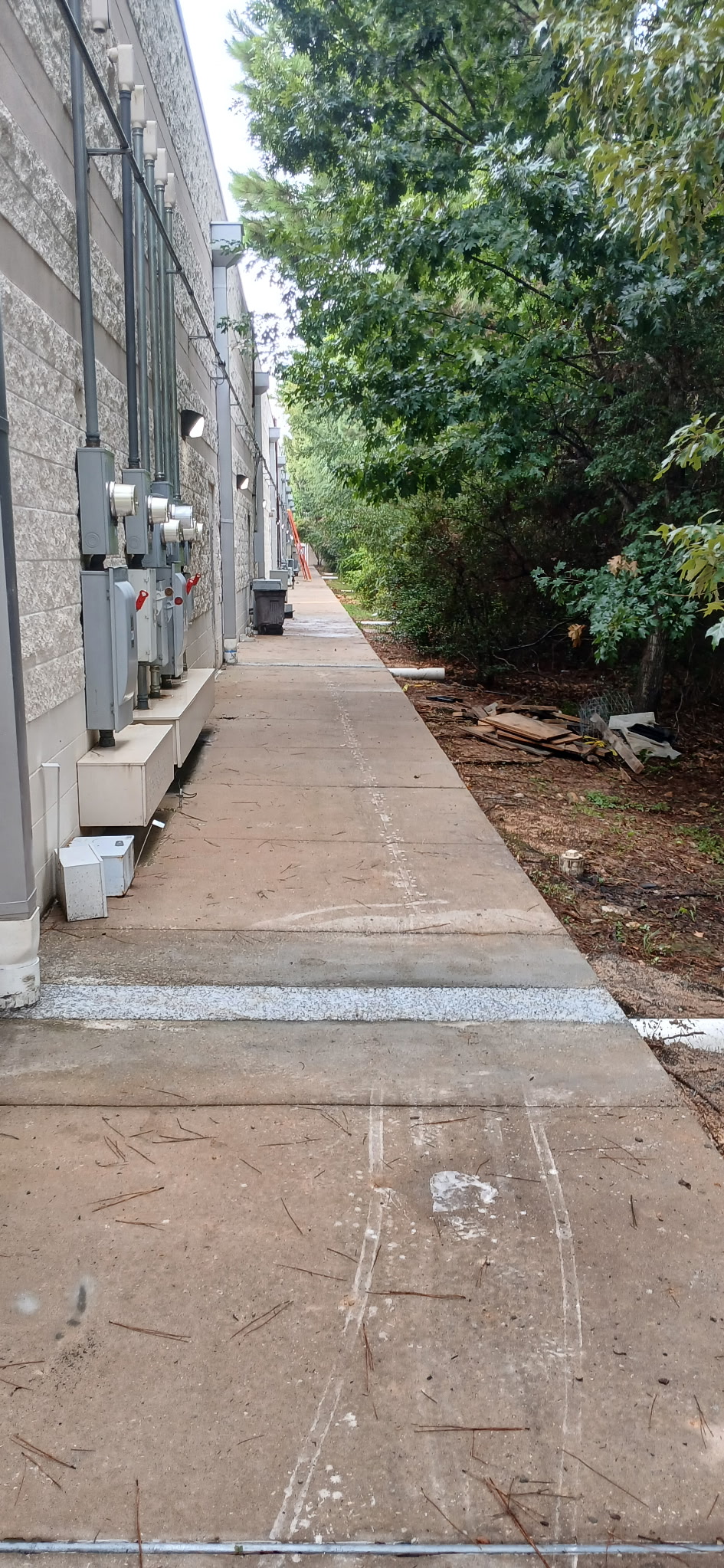
After. The line is in, the concrete is restored, and the corridor is dry. This is what the back of the building is supposed to look like.
Storm Drain Tie-Ins and Site Drainage from MSM Services Texas
MSM Services Texas installs underground drainage systems for retail centers, office parks, industrial buildings, and mixed-use properties across Greater Houston. Downspout collection, AC condensate tie-ins, trenching and solid PVC piping, storm drain and detention connections, and full concrete and exterior restoration when the pipe is in the ground. When the drainage problem runs out into the lot, which it usually does, we handle the asphalt and paving repair under the same contract.
For properties on a recurring maintenance contract, we inspect discharge points as part of the routine walk, so an eroding corridor gets caught while it is still a $9,000 problem. Owners who want the drainage risk priced into a real capital plan rather than discovered during an emergency should also talk to our sister company, Olivewood Management.
We will walk your property, tell you where the water is actually going, photograph what it has already done, and give you a written scope and price. If your building does not need the work, we will tell you that too.
Find Out Where Your Roof Water Is Going, Before Your Foundation Tells You
Free site walk. We'll document every downspout and condensate discharge on the building, locate the nearest storm drain or detention outfall, and quote the tie-in, typically within 48 hours of the visit.
A $7,000 to $15,000 drainage tie-in protects a foundation and a site that cost six figures to put back. Call MSM Services Texas at 713-322-9095 or request a free estimate online. We serve commercial properties in Katy, Sugar Land, Cypress, Pearland, Spring, and across the Houston metro, and we will get the water off your building and into the storm drain where it belongs.