Parking lot striping is one of those maintenance items that looks simple from the outside and gets complicated fast once you're actually scoping the work. The main question property managers face: do you need a full lot repaint, or can you get another service cycle out of a targeted restripe? The answer affects your budget, your timeline, and whether the job holds up for two years or five.
What's the Difference?
A restripe applies fresh paint directly over existing lines that are still legible and bonded to the surface. The layout stays the same — you're just restoring visibility. It's faster, less expensive, and appropriate when the underlying markings are in decent shape.
A full repaint (sometimes called a layout repaint) involves re-measuring and restriping the entire lot from scratch — or close to it. This is necessary when the lot has been resurfaced or overlaid, when lines have shifted or drifted over multiple restripe cycles, when you're reconfiguring the layout, or when the existing paint is so degraded that painting over it produces a muddy, inconsistent result.
When a Restripe Is the Right Call
A restripe makes sense when all of the following are true:
- Lines are faded but the layout is accurate and stalls are still legible
- The pavement surface hasn't been overlaid or significantly patched
- No layout changes are needed (no new accessible stalls, reconfigured drive lanes, etc.)
- Existing paint is still bonded — no peeling, lifting, or severe cracking under the stripe
In Houston's climate, UV degradation and heat accelerate paint fade significantly. A well-applied stripe in a high-sun exposure lot can show meaningful fading within 18–24 months. That's a restripe situation — not a repaint.
When You Need a Full Repaint
A full repaint becomes necessary when:
- The lot has been resurfaced. Asphalt overlays cover existing lines completely, and new markings have to be laid out fresh from measurements.
- Lines have drifted over multiple restripe cycles. Each application that isn't precisely aligned compounds the drift. After two or three cycles of sloppy restriping, stalls can be inches off from where they should be.
- You're adding or reconfiguring accessible parking spaces. ADA-compliant accessible stalls and access aisles have dimensional requirements that can't just be eyeballed over old lines.
- Paint is peeling, flaking, or coming up with the surface. Painting over delaminating markings will fail quickly. The surface needs to be addressed before new paint goes down.
The Product: Why We Use Sherwin-Williams Pro-Park
For commercial parking lot striping in the Houston area, our standard specification is Sherwin-Williams Pro-Park Waterborne Traffic Marking Paint. It's engineered specifically for parking lot and traffic marking applications — low VOC (under 50 g/L), compatible with airless line stripers, and formulated to hold up against UV exposure, rain, and regular vehicle traffic.
The waterborne acrylic formulation matters in Houston for two reasons: it dries fast enough to reopen a lot the same day in warm weather, and it doesn't soften or track the way oil-based coatings can in extreme summer heat. For accessible parking markings — where blue paint and specific hatching patterns are required — Pro-Park is available in the full range of traffic marking colors so you can complete a compliant accessible stall layout without switching products.
On a full repaint, we apply two coats to ensure consistent film build and adequate opacity over dark asphalt. On a restripe over existing lines in reasonable condition, a single pass is typically sufficient.
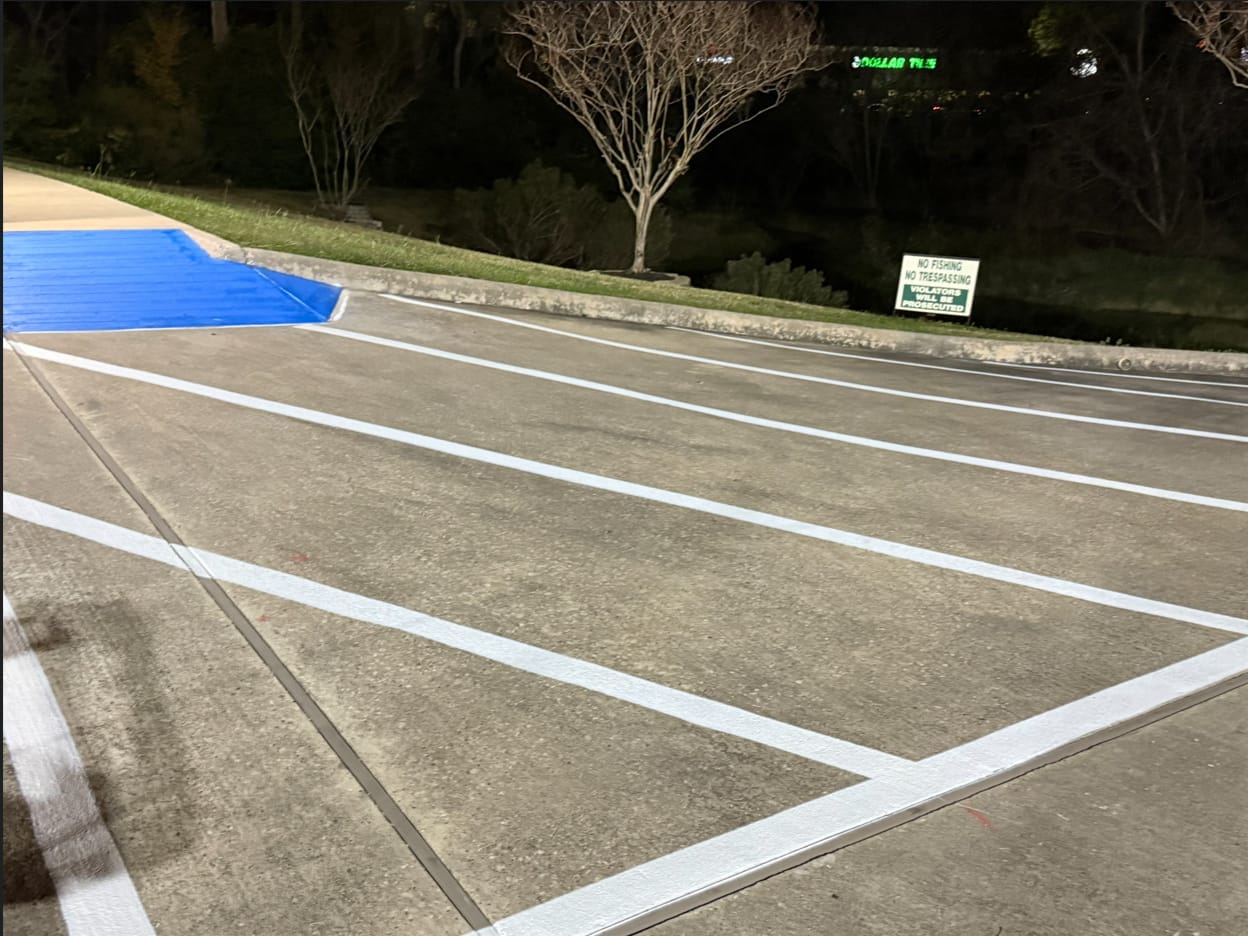
A completed parking lot stripe job — clean, consistent lines applied with an airless line striper for uniform width and edge definition.
Line Width and Color Standards
Parking lot markings aren't arbitrary — they're governed by federal and state standards that establish minimum line widths, colors, and retroreflectivity requirements. The federal baseline is set by the FHWA Manual on Uniform Traffic Control Devices (MUTCD), Chapter 3B, which covers pavement marking color, width, and application standards for parking and traffic environments. In Texas, those standards are further detailed in the TxDOT design manuals , which specifies material requirements, glass bead retroreflectivity standards, and acceptance criteria for commercial and public pavement markings.
For most commercial parking lots: stall lines are white, 4 inches wide minimum; fire lane curbs are painted red; accessible stall borders and the “NO PARKING” hash lines in access aisles are blue. Those color assignments aren't suggestions — they're the standard, and inspectors and insurance underwriters treat them accordingly.
ADA Marking Requirements
Accessible parking spaces have specific marking requirements that go beyond color. The ADA Compliance Brief on Restriping Parking Spaces from ADA.gov lays it out clearly: accessible stalls must be at least 96 inches wide, with an adjacent access aisle of at least 60 inches (96 inches for van-accessible spaces). The access aisle must be marked to discourage parking in it — typically a diagonal hash pattern in blue — and it must adjoin the accessible route to the building entrance.
This is where restripe-only projects often get complicated. If your accessible stalls are undersized, or if the access aisle markings have degraded to the point of being invisible, a restripe won't bring you into compliance — the underlying layout has to be corrected first. On any job that involves accessible stalls, we measure before we paint.
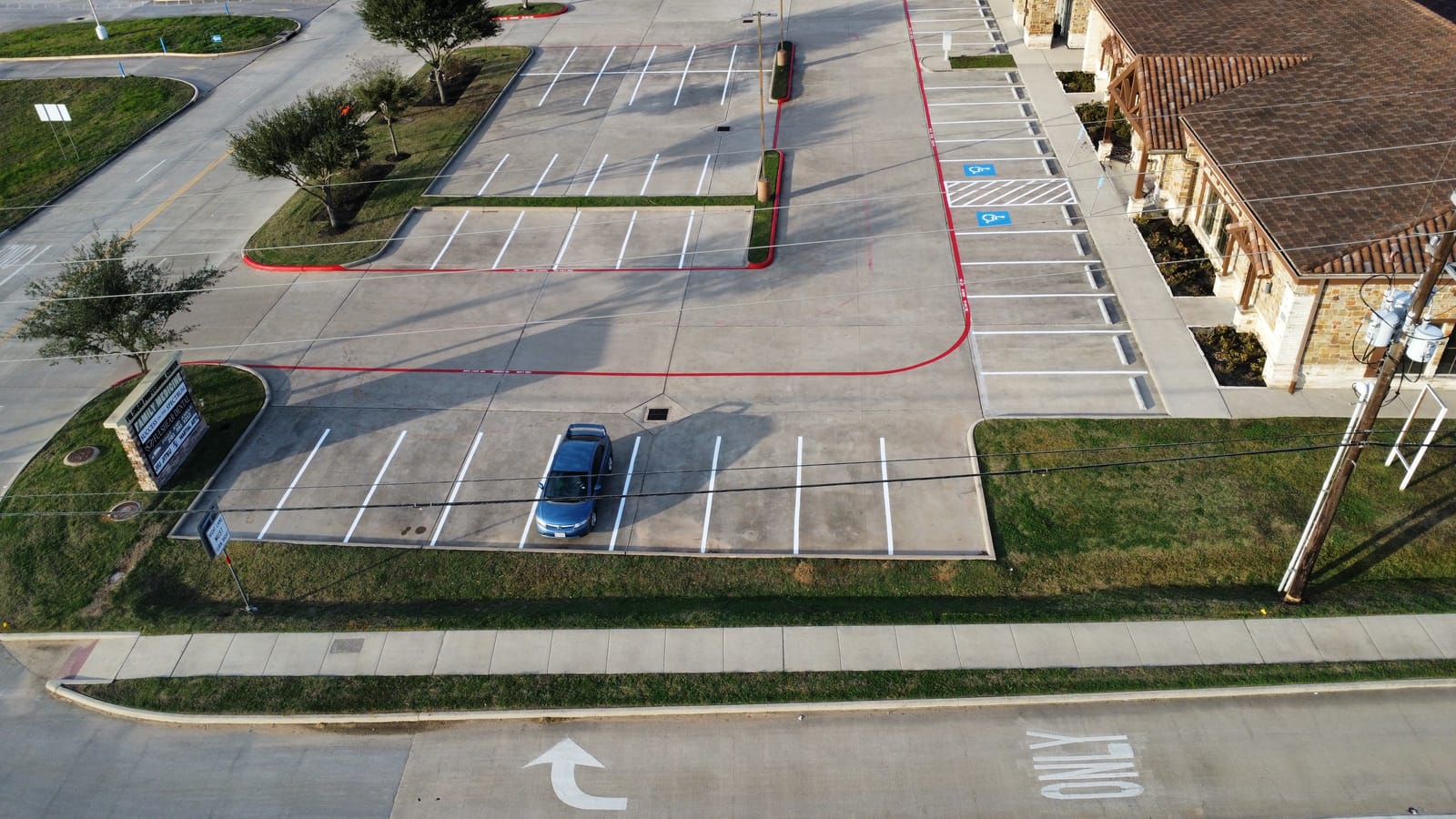
Properly marked accessible parking stalls with clearly defined access aisles — a common scope item on full lot repaints.
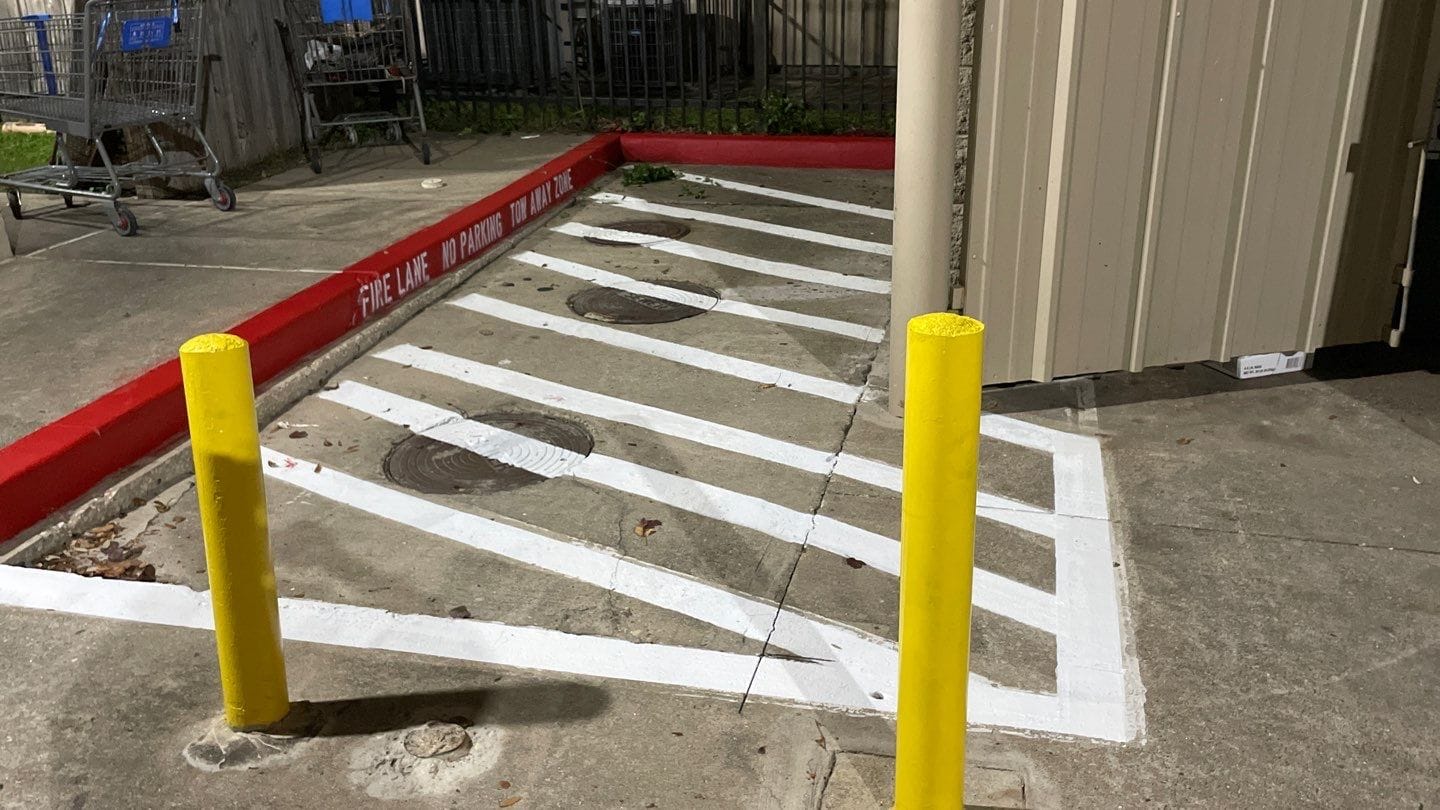
Full lot layout repaint underway — measured, laid out, and applied with an airless line striper for consistent results across the entire surface.
The Practical Decision Framework
Walk your lot and ask three questions:
- Are the lines still in the right places, or has the layout drifted?
- Is the surface intact, or has it been overlaid, heavily patched, or resurfaced?
- Are all accessible stalls and access aisles dimensionally compliant?
If the answer to all three is yes, you're probably in restripe territory. If any of them is no, budget for a full repaint and a proper layout. The cost difference isn't as large as people expect — labor and mobilization make up the majority of the job cost regardless — and a restripe applied over a flawed layout just locks in the problem for another cycle.
Get Your Lot Restriped by MSM Services Texas
MSM Services Texas handles parking lot restriping, full layout repaints, ADA compliance markings, and fire lane striping for retail centers and commercial properties across Greater Houston. We use commercial-grade traffic paint, work nights and weekends to avoid disrupting your tenants, and provide free on-site estimates with transparent pricing built for your R&M budget.
Not sure if your lot needs a restripe or a full repaint? Call 713-322-9095 or request a free quote — we'll walk your lot and give you a straight answer before any work is scoped. No pressure, no upselling. Just an honest assessment from a team that's restriped 300+ commercial lots across Houston, Katy, Sugar Land, The Woodlands, and surrounding areas.