There are very few maintenance investments that return as much visible improvement per dollar spent as pressure washing. A clean building face, sidewalks, and common areas signal that a property is actively managed. The opposite signal — staining, mildew, and grime buildup — communicates neglect even when everything else is functioning fine. And if you have a municipality or HOA issuing notices about building appearance, a proper wash is often the fastest way to close that out.
What Should Be on the Rotation
For most commercial properties in Greater Houston, a full service should cover building facades, sidewalks and walkways, dumpster enclosures, loading docks, drive lanes, and common area hardscape. Dumpster areas and loading docks accumulate grime fastest and typically need more frequent attention than the rest of the property — more on that below.
Softwashing Building Facades: How We Actually Do It
High-pressure washing alone is not always the right tool for building exteriors. On stucco, painted CMU, EIFS, and similar surfaces, blasting with high pressure can damage the substrate, force water into wall cavities, and strip coatings — none of which helps your building look better or last longer.
For building facades, we use a softwash approach: a mix of sodium hypochlorite (SH) and a surfactant — essentially a fabric-type soap — applied at low pressure and left to dwell on the surface. The surfactant does two things: it helps the solution cling to vertical surfaces instead of running straight off, and it helps it penetrate into pores and surface irregularities. The SH does the actual work — it chemically kills mildew, algae, and organic staining at the root rather than just blasting the visible growth off the surface. After the dwell period, we rinse clean.
The result holds significantly longer than a straight pressure wash because the organism causing the staining is dead, not just dislodged. If your HOA or municipality has flagged your building for staining or biological growth, a softwash is the correct remediation — not just a high-pressure pass that will show regrowth in a few months.
For more on the chemistry behind softwashing and industry application standards, the Softwash Technologies SH 101 guide covers SH concentration, surfactant use, and surface-specific application. Industry best practices for professional exterior cleaning cover chemical handling, application technique, and environmental compliance.
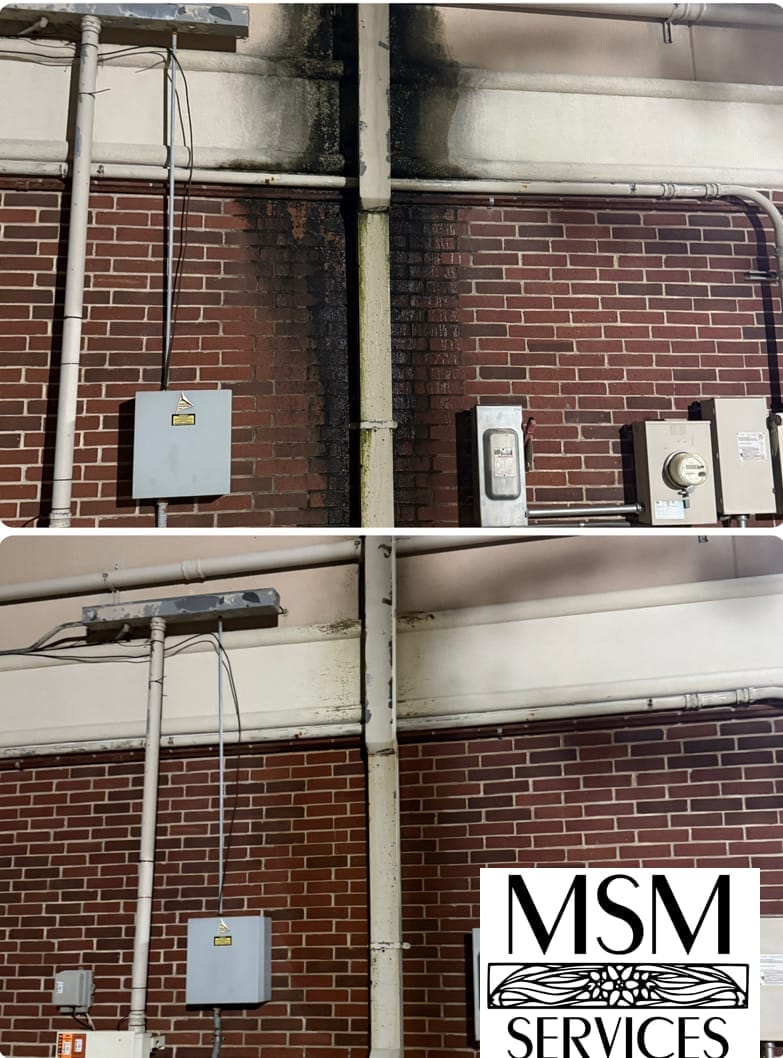
Low-pressure softwash on a commercial building facade — SH and surfactant applied to dwell before rinsing, eliminating mildew and organic staining at the source.
Dumpster Enclosures and Grease Traps: The Worst Job on the Property
Dumpster enclosures are in a different category from the rest of a commercial property cleaning program. The grease accumulation that builds up around grease trap drains and on enclosure floors is not just dirty — it is actively destructive to concrete. Grease and cooking oils penetrate the surface, break down the cement paste in the slab, and over time cause pitting, staining, and structural degradation that no amount of cleaning will reverse. Getting ahead of it is significantly cheaper than replacing concrete.
Our process for heavily soiled enclosures starts before the water comes out. The first step is physically removing the top layers of accumulated grease with a flat-top shovel. This isn't glamorous, but it's necessary — trying to wash through several inches of compacted grease buildup with hot water alone is inefficient and won't get you down to the concrete surface. Once the bulk material is removed, we apply soap and hit the surface with 130°F hot water. Hot water at that temperature cuts grease at a fundamentally different level than cold or warm water — it lowers surface tension and breaks the bond between the grease and the concrete rather than just moving it around. Industry equipment manufacturers confirm that 100–130°F is the optimal temperature range for grease and oil removal, where detergents work fastest and grease bonds break down most efficiently.
Even with that process, heavily neglected enclosures rarely come fully clean on the first visit. Years of buildup don't come off in one pass, and expecting them to sets up an unrealistic standard. What the first visit does is remove the majority of the material and get the surface to a point where follow-on maintenance can actually keep up with it.
For dumpster enclosures, especially those with active grease trap drains, we recommend a cleaning cycle of every 3 to 6 months. That frequency keeps accumulation manageable, prevents the concrete degradation that comes from long-term grease saturation, and keeps the area from becoming a health and odor issue for tenants and customers.
One note on wastewater: grease trap washout generates contaminated runoff that cannot be discharged to storm drains. The EPA's stormwater best management practice guidance is clear that washwater containing grease, oil, or detergent must be contained and directed to sanitary sewer — not surface drainage. We handle this as part of our standard process.
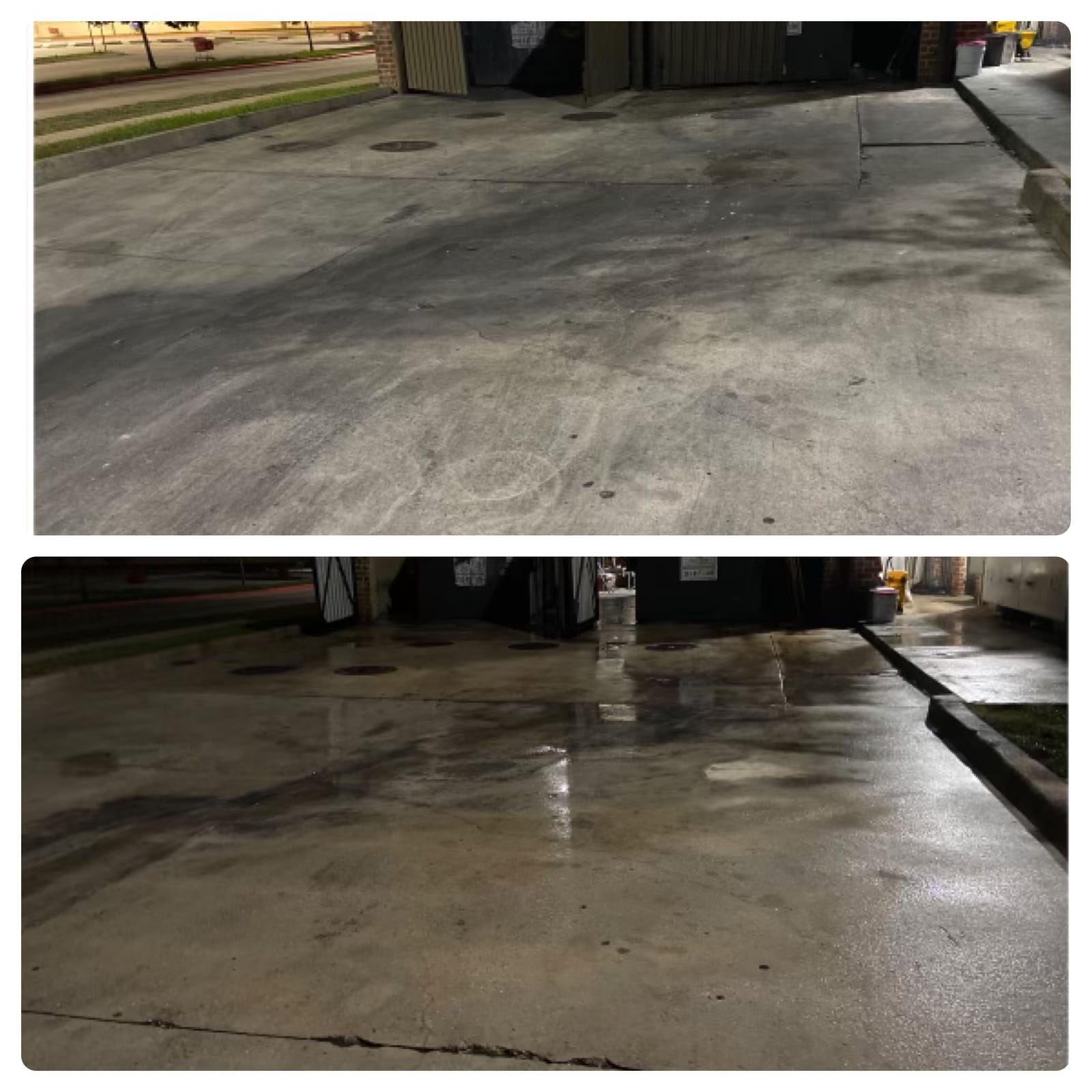
Dumpster enclosure cleaning with hot water and degreaser — bulk grease removed first, then hot water and soap to break down what remains.
Houston's Climate Makes It Non-Optional
Humidity, heat, and rainfall create ideal conditions for algae, mildew, and organic staining. Properties in Houston that skip exterior washing for more than 12–18 months typically show significant biological staining on north-facing walls and shaded walkways. The longer it's left, the harder the remediation — and the more likely it is to draw a notice from an HOA or code enforcement. Annual building washing keeps it manageable. Dumpster enclosures need more.
Commercial Pressure Washing from MSM Services Texas
MSM Services Texas provides commercial pressure washing and soft washing for retail centers, office parks, and commercial properties across Greater Houston. Building exteriors, sidewalks, parking garages, dumpster pads, and common areas — cleaned on a one-time or recurring schedule.
Need a quote for pressure washing your commercial property? Call 713-322-9095 or request a free estimate. We'll assess your property and build a cleaning schedule that fits your R&M budget — no surprises, no hidden fees.