A well-executed exterior repaint is one of the highest-return investments a retail property owner can make. It improves curb appeal immediately, signals to tenants and customers that the property is actively managed, and done right, it protects the building envelope for a decade or more. Done wrong, it's a $50,000 mistake that starts showing at year four or five.
We've seen both outcomes. Here's what separates them.
The Product: Why We Specify Sherwin-Williams Loxon XP
For exterior masonry and concrete commercial buildings in Houston, our standard specification is Sherwin-Williams Loxon XP Waterproofing Masonry Coating. It's a high-build, direct-to-masonry coating engineered specifically for the demands of exterior commercial surfaces — no separate primer required, exceptional resistance to wind-driven rain, efflorescence, and alkali, and it holds its appearance over an extended service life.
Houston's climate is particularly hard on exterior coatings. The combination of UV intensity, heat, humidity, and driving rain means you need a product that was engineered for those conditions — not a general-purpose paint applied to a commercial surface because it was available at the supply house. Loxon XP is purpose-built for this application, and we've seen it perform consistently on retail and commercial properties across the Houston metro.
Application: Spray and Roll for Full Coverage
The application method matters as much as the product. On commercial masonry exteriors, we use a spray and roll combination — spray the material on to ensure consistent film build and full penetration into the texture of the substrate, then immediately back-roll to work the coating into voids, pores, and surface irregularities that a sprayer alone can miss.
This technique takes more time than spray-only application, but the result is a coating that's actually bonded to the surface rather than just sitting on top of it. On textured block or CMU walls — which are common on retail buildings in the Houston market — spray-only leaves air pockets and thin spots that become entry points for moisture. Those are the spots that start peeling at year three. The spray and roll combination eliminates them.
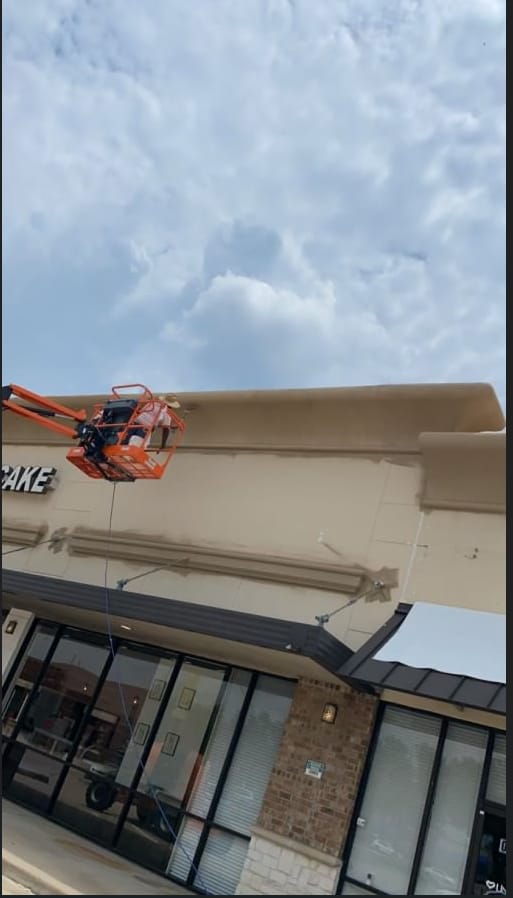
Spray and roll application on a commercial exterior — consistent coverage across the full wall surface.
Prep Work: The Part That Determines How Long It Lasts
This is where most paint jobs succeed or fail, and it's the part that's hardest to evaluate from a bid. Proper prep on a commercial masonry exterior includes pressure washing to remove dirt, mildew, and chalking; crack repair and caulking at joints, penetrations, and transitions; surface profiling where needed; and allowing adequate dry time before coating goes down. None of that is fast, and none of it is cheap. But skipping it is far more expensive.
We recently saw a new development here in Houston — a retail strip built in the last few years — where the exterior coating was already visibly failing. Peeling, bubbling, and staining across entire elevations. The property was past its contractor warranty period, so there was no recourse there. The root cause was straightforward: the walls weren't properly prepped before paint was applied. On a new build, the substrate often has residual form release compounds, high alkalinity from fresh concrete, and moisture that needs to cure out. Apply paint before those conditions are addressed and you're essentially applying it to a surface it can't bond to.
Now that property's HOA is fining the owner and requiring a full repaint. What was originally a maintenance cost they were trying to minimize has turned into a full remediation project — strip, prep, and recoat from scratch — on a building that shouldn't need it yet. It's a frustrating situation that's entirely avoidable.
We paint with a 10-year-plus service life in mind on every job. That means using the right product, applying it the right way, and — critically — doing the prep work that makes both of those things matter. You don't want a $50,000 paint job that looks like it needs redoing in five years.
A Paint Job That Opened Up Capital
One of our clients engaged us to repaint a retail building in the Houston area — a project they viewed as routine maintenance. The results were significant enough that when they went to refinance the property shortly after, the bank assessed the paint job as a capital improvement rather than maintenance. The building appraised at a meaningfully higher value, and our client was able to pull equity out of a project they had budgeted as an operating expense.
That outcome isn't guaranteed, and it isn't the reason most people repaint. But it illustrates something real: a well-executed exterior repaint changes how a property is perceived — by tenants, by customers, and apparently by lenders. When the transformation is significant enough, it gets treated accordingly. The difference between a paint job that looks like maintenance and one that looks like an upgrade is almost always prep work and product quality.
Before & After
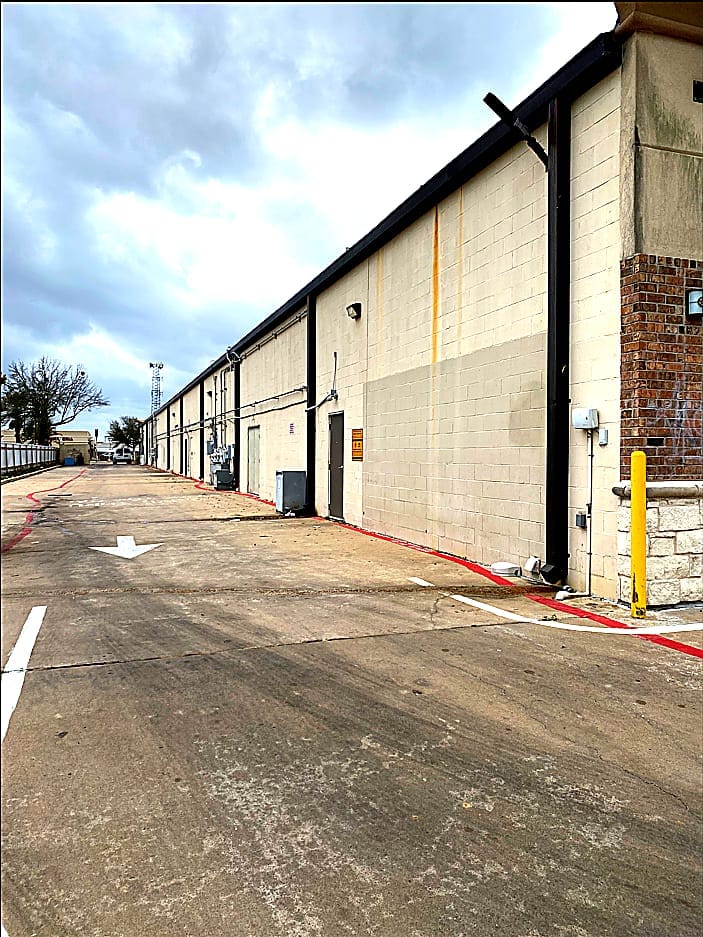
Before
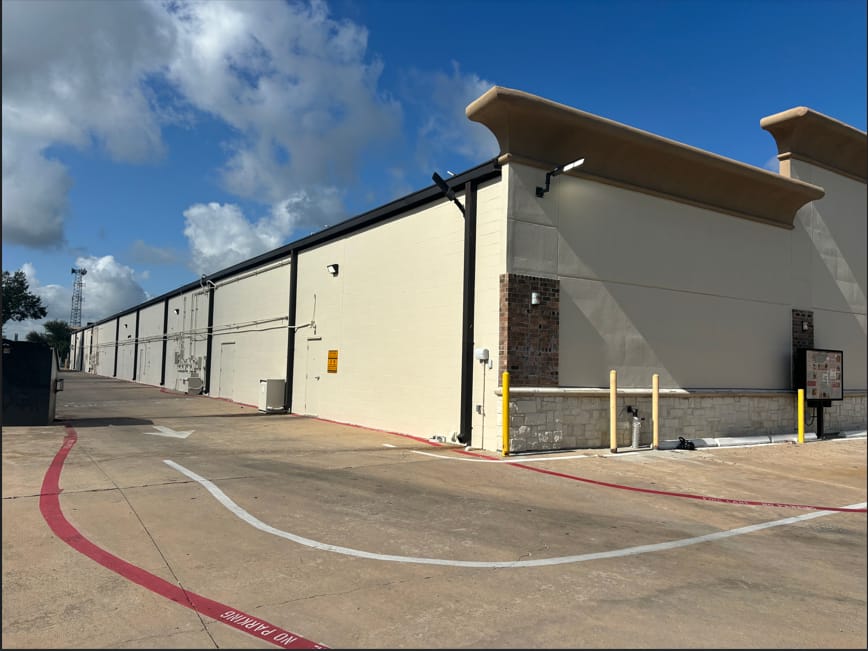
After
Commercial Repaints from MSM Services Texas
MSM Services Texas provides full center repaints for retail centers, office buildings, and commercial properties across Greater Houston. We handle surface prep, primer, finish coats, and detail work — phased around your tenants so business keeps running.
Planning a repaint for your property? Call 713-322-9095 or request a free estimate. We'll walk the building, assess the scope, and give you a transparent quote you can build into your R&M budget.