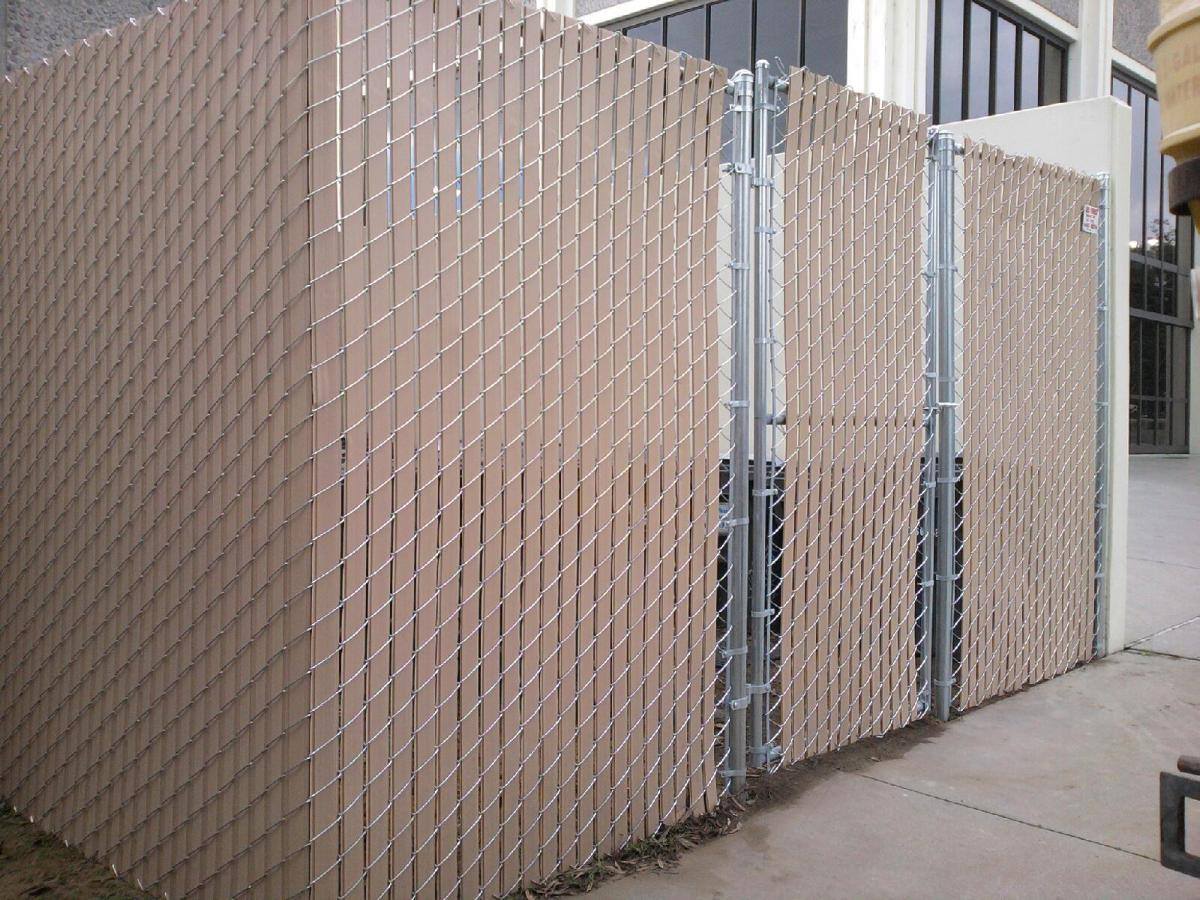
A chain link enclosure with privacy slats. The gates and drop rods are the parts that fail first, usually within a year of the first haul truck hit.
Nobody tours a retail center from the back. The dumpster enclosure sits behind the building, out of sight of the leasing sign, and it takes more abuse than any other structure on the property. A front-load truck opens it several times a week. Tenants prop the gates open with whatever is handy. Restaurant grease, cardboard, and wind all work on it at once. Most property managers find out it has failed when a tenant emails a photo of a gate lying in the drive lane.
We repair enclosures on retail centers and office properties across Houston every month, and the pattern is consistent: a missing drop rod that was never replaced turns into a $900 weld, and a $900 weld that was put off turns into a $3,700 rebuild. November is a good time to look. Holiday cardboard volume peaks over the next six weeks, and a gate that will not latch now will be standing open in a pile of boxes by Christmas.
Here is how enclosures fail, what the repairs have actually cost on jobs we have done this year and last, and the permit and dumping rules that come with the bay.
How a Dumpster Enclosure Actually Fails
An enclosure is a simple structure: three walls, two gates, a concrete pad. The failures are just as predictable. In the order we see them:
- Drop rods. The vertical rods that pin each gate to the pad when it is open or closed. They bend when a driver swings a gate without lifting the rod, then go missing. Without them, gates swing in the wind, slam into the haul truck, and hit parked cars.
- Hinges. A steel gate is heavy, and every swing loads the hinge welds. Light hinges or bolted hinges fatigue, crack, and eventually let the gate drop onto the pad. Once a gate drags, drivers start shoving it, and the frame racks.
- Latches. Missing or bent latches mean the gates cannot be closed or locked, which is the start of almost every illegal dumping problem we deal with.
- Frames and facing. Wood pickets rot and split. Chain link slats blow out. Light steel frames twist after a few truck hits.
- Walls. Masonry (CMU) walls crack where the container gets pushed back into them. Without a bollard or curb stop at the back wall, the container does the damage every time it is set down.
- The pad and apron. Loaded trucks crack the approach slab, and water sits in the low spots. If the pad slopes toward a storm inlet, so does everything that leaks out of the container.
What Enclosure Repairs Actually Cost
These are real line items from enclosure work MSM Services Texas has completed on commercial properties in the Houston area since mid-2025. Your scope will differ, but this is the range a property manager should expect to see on a quote.
| Scope | Where | Billed |
|---|---|---|
| Rehang a fallen gate, two new hinges welded, plumb and level | Pearland | $623–$765 |
| Two new 9" industrial square hinges welded to post, primer finish | Spring | $925 |
| One new drop rod, five wood pickets painted to match, gates adjusted to close | Katy | $850 |
| Four new 3/4" drop rods, two fabricated latches for a padlock, corrosion spot-welded | Spring | $975 |
| Three new drop rods and a replacement 2x2 steel door frame | Katy | $985 |
| Repair a 9-ft chain link gate with privacy slats | Missouri City | $975 |
| New fabricated gate (R-panel face on 2x2 steel frame), six hinges, two latches, three drop rods | Houston | $3,725 |
| New CMU wall section, 10 ft long by 8 ft high, painted to match | Houston | $5,750 |
| Repaint the CMU walls of two single bays (Loxon masonry coating) | Katy | $1,100 |
| Wash a single dumpster bay with pre- and post-treatment | Pearland | $290 |
| Chain and padlock an unused bay | Pearland | $300 |
| Install two no-dumping signs per bay on five bays (owner-supplied signs) | Missouri City | $500 |
| Haul off bags, pallets, and packaging left around a bay | Various | $225–$400 per visit |
Two things stand out. First, almost every routine repair lands between $600 and $1,000. That is a mobilization, a welder, and a few hours, whether the fix is one hinge or four drop rods. Bundling everything wrong with the enclosure into one visit is far cheaper than calling three times. Second, the jump from repair to rebuild is steep. The $3,725 gate was a gate that had been rehung more than once before it was finally replaced.
The Permit and Screening Rules That Come With the Bay
Inside the city limits, the City of Houston requires a combustible waste storage (dumpster) permit for any container over 50 cubic feet, or any container that stays on site more than 60 days. That covers essentially every commercial front-load container. The detail that catches buyers: the permit does not transfer between property owners. If your property just changed hands, the new owner needs its own permit.
Screening is the other piece. Under the city's residential buffering ordinance amendments, commercial building permits filed since February 25, 2023 must show the dumpster location on the site plan and provide screening when the dumpster sits next to a street or a residential property. If you are permitting a renovation or a pad site build-out, expect the enclosure to be part of the review.
Suburban cities write their own rules. Katy, Sugar Land, and The Woodlands each have their own screening and enclosure standards, and HOA or deed restrictions on many suburban centers add another layer. Check before you change materials. Swapping wood pickets for chain link is cheaper, but it is not always allowed.
An Open Gate Is an Invitation to Dump
Illegal dumping is a crime in Texas, and the penalties scale with weight and volume. As the Fort Bend County Environmental Health summary of Health and Safety Code 365.012 lays out, it runs from a Class C misdemeanor for a few pounds to a state jail felony at 1,000 pounds or 200 cubic feet. None of that helps the owner, though. When a mattress, a stack of tires, or a pickup load of construction debris shows up beside the container on a Monday morning, the property pays to haul it off, and the hauler will not take what is outside the container.
What actually cuts dumping on the properties we maintain:
- Gates that close and lock. Working latches, a padlock hasp, and drop rods that hold the gate shut. Give the lock code to the hauler and the tenants, not to the world.
- Lock out bays you do not use. An empty bay is a free drop-off point. A chain and padlock costs about $300.
- Signage. Posted no-dumping signs at each bay give the police something to cite and make the property easier to defend.
- Light. A dark back-of-house is where dumping happens. A working wall pack over the enclosure is one of the cheapest deterrents there is.
- Fast cleanup. A pile attracts more piles. Our junk haul-off crews clear bays the same week, often the same day, so it does not become a standing drop site.
Grease, Leaks, and the Storm Drain Next Door
On centers with restaurant tenants, the enclosure is also an environmental problem. Grease and food waste leak from containers and trap lids, coat the pad, and run with the next rain toward the nearest storm inlet. That slick is a slip hazard for the hauler and a stormwater issue for the owner.
The fix is a hot-water wash of the pad and the path to the drain, done on a schedule, with the washwater handled properly. The EPA's wash water best management practice is written for vehicle washing, but the principle is the same one we follow: contain the water and keep it out of storm drains. Our commercial pressure washing crews pre-treat the bay, wash with heated water, and post-treat to break down what is left. If the pad drains poorly to begin with, read our post on where your roof water actually goes, because the same grading problems show up at the dumpster.
What This Looked Like on One Houston Center
In August 2025 we walked a retail center inside the Houston city limits with restaurant tenants sharing a double dumpster bay. One gate had been rehung more than once and was past saving. The hinges on both gates were rusted through, two of the drop rods were gone, and there was no working latch, so the bay stood open around the clock. Between the container and the storm drain, a 30 ft by 60 ft stretch of pavement was coated in grease.
We quoted it as one package. A new fabricated gate with an R-panel face on a 2x2 steel frame, six heavy-duty hinges across both gates, two new latches, three new 3/4" drop rods, spot welds on the corroded moving parts, and the existing gate remounted: $3,725. Two high-temperature washes of the grease area: $900. The same visit picked up two new 6" concrete-filled bollards, brick and stucco repairs, and the regular walkway wash, so the property paid for one mobilization instead of five.
The contrast is the work we did on two separate Pearland centers this year: a gate rehung with two new hinges for $765 in March, and a fallen gate remounted for $623 in May. Those were caught early. The Houston gate is what the same problem looks like after it has been patched and ignored for a few years.
Sometimes the right answer is a wall, not a gate. On another Houston property in September 2025, the fix was a new 10 ft by 8 ft CMU wall section at the rear bay for $5,750, plus 120 linear feet of 6 ft galvanized chain link with privacy slats behind the trash bins. That property had been fielding complaints about visible trash from the street. It does not anymore.
Specs That Make an Enclosure Last
When we build or rebuild an enclosure, these are the details we hold to:
- Welded, heavy-gauge hinges. Industrial square hinges welded to the post, not light strap hinges bolted on. Three per leaf on tall or heavy gates.
- 3/4" drop rods with sleeves cored into the pad at both the open and closed positions, so the gate is pinned wherever the driver leaves it.
- A steel frame, at least 2x2, with metal or R-panel facing where the city allows it. Wood looks good for two years.
- A padlock-ready latch. If the gate cannot be locked, it will not be.
- Protection for the back wall. A pipe bollard or curb stop so the container cannot be pushed into the masonry. Our bollard and wheel stop crews install these with the gate work.
- Primer and paint on every weld. Bare steel at a dumpster bay rusts in one Houston summer.
Dumpster Enclosure Repair from MSM Services Texas
MSM Services Texas builds and repairs dumpster enclosures, gates, and fencing for retail centers, office buildings, and commercial properties across Greater Houston. One crew handles the welding, the gates, the masonry and exterior repair, the bollards, the wash, and the haul-off, so the whole bay gets fixed on one visit and one invoice, with photos of the finished work for your files.
For properties on our annual maintenance contract, the enclosure gets checked on every visit: drop rods, hinges, latches, and the pad. A missing drop rod gets replaced while it is still a small part, not a fallen gate.
Get the Dumpster Bay Fixed Before the Holiday Cardboard Hits
Send us a photo or let us walk it. We'll quote the gates, rods, latches, walls, and cleanup as one line-by-line scope, and most enclosure repairs are done in a single visit.
A gate that will not latch is a dumping site waiting to happen. Call MSM Services Texas at 713-322-9095 or request a free estimate online. We repair enclosures in Spring, Missouri City, Cypress, and across the Houston metro, and we will tell you straight whether it needs a weld or a rebuild.